
Convert PDF to LaTeX
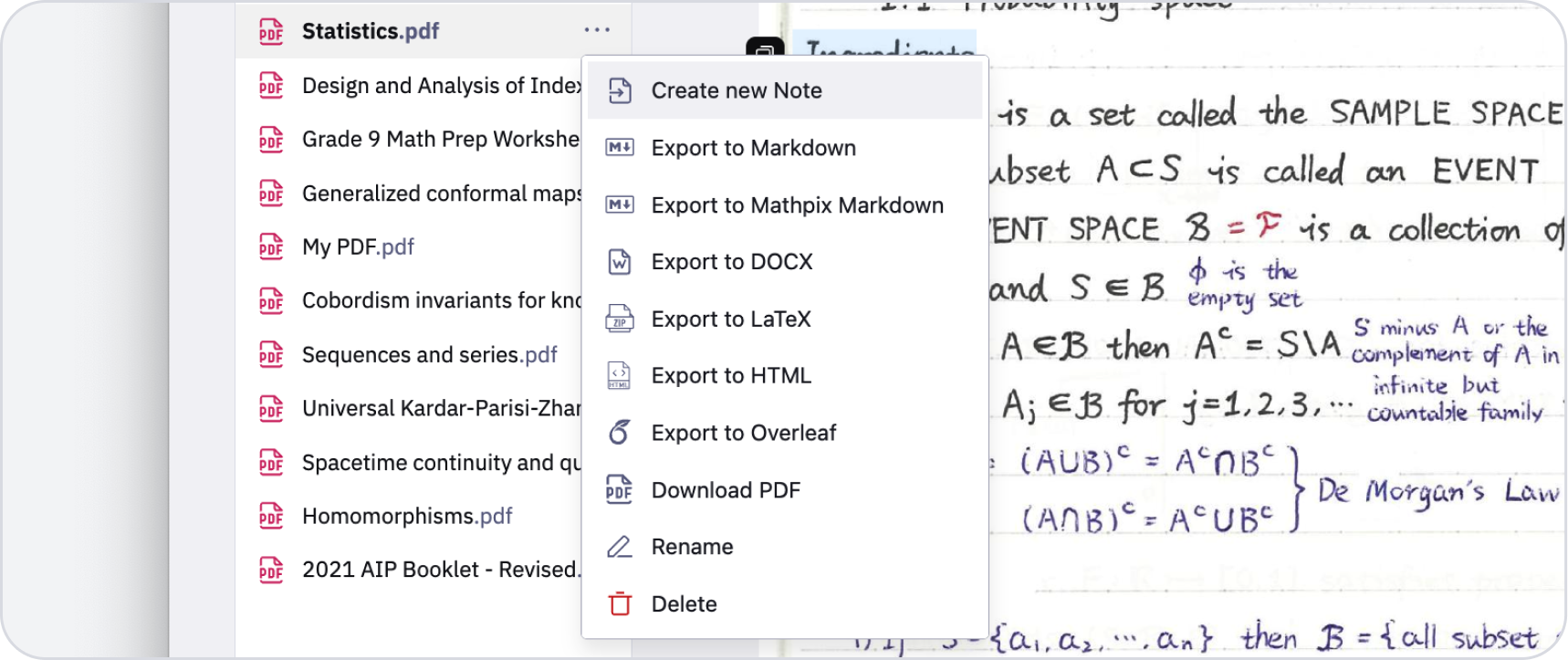
Mathpix Snip converts scientific PDFs to editable LaTeX files in minutes. Export as .zip or open directly in Overleaf.
- Equations come back as LaTeX source, not as images
- Theorems, lemmas and proofs keep their environments
- Two-column journal layouts read in the right order
- Easy exporting to Overleaf in seconds
LaTeX that compiles
Recognizing a research paper means recognizing its structure, not only its characters. Equations, theorem environments, algorithm blocks and figure captions each come back as themselves.

Equations come back as source
You get the LaTeX, not a screenshot. That is the difference between a paper you can build on and a PDF you can only read.
Theorem environments are preserved
Theorems, lemmas, corollaries and proofs are a documented Mathpix Markdown structure, so they export as environments rather than as bold paragraphs.

Algorithm blocks keep their shape
Pseudocode blocks are recognized as their own structure instead of being reflowed into prose and losing their line breaks.
What Mathpix recognizes in PDF files
Reading order on multi-column pages
The two-column layout most journals use is resolved during recognition, so the LaTeX is in reading order rather than column order.
Algorithms keep their line structure
The lines.json conversion format returns code and pseudocode line types, and algorithm and pseudocode diagram subtypes.
Per-line geometry and confidence
Every line carries a bounding box and a confidence score, so a long document can be spot-checked where the model was least sure.
Mathpix is ace. That’s the best results I got so far for scientific papers and reports. It understands the layout of complex documents very well, it’s quite impressive.
How to convert PDF to LaTeX
1
Upload the paper
Drag the PDF into the Mathpix Snip web editor, or pick it from your files.
2
Choose which pages to convert
Enter a page range, or leave it blank for the whole document. Useful when you only need one section of a long paper.
3
Let the recognition run
Equations become LaTeX source, theorem environments stay environments, and two-column pages come back in reading order.
4
Export the LaTeX source
Export → LaTeX in the top right, as a .tex file or a zip carrying the figures with it.
What Mathpix accepts, and the limits that apply
Which files you can send
PDF, EPUB, Word (DOCX, DOC), PowerPoint (PPTX), OpenDocument Text (ODT), DjVu, WordPerfect (WPD), Mobipocket (MOBI) and Amazon Kindle (AZW3)
What you get back
A tex.zip archive carrying the LaTeX source and the extracted figures alongside it. The same conversion opens directly in Overleaf.
The size limits that apply
One PDF, uploaded: 1 GB
Files API, per file: 15 GB
Files API, files per job: 200,000
Our PDF to LaTeX conversion tools
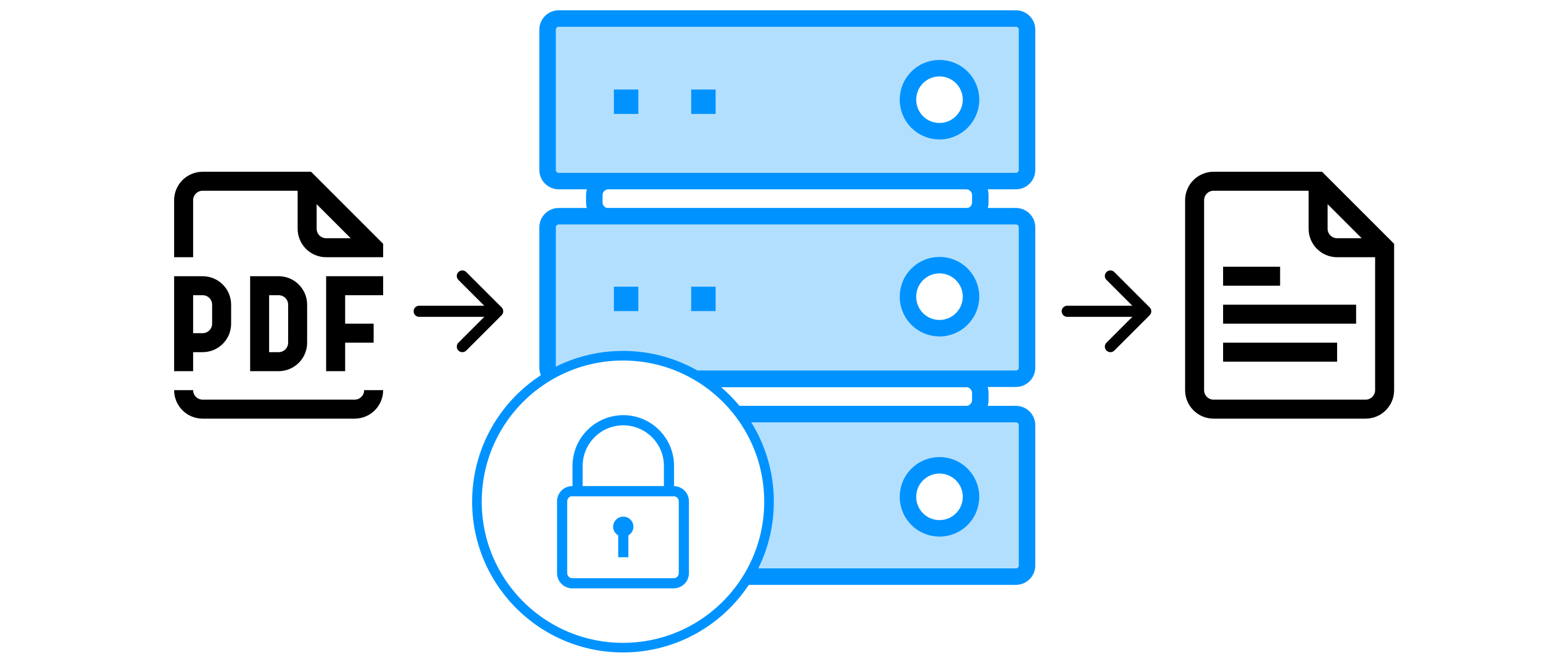
On-premise PDF Cloud
Use all PDF processing features with a self-hosted, fully contained solution.
Learn more
Converting PDF to LaTeX: common questions
Do I get the LaTeX for the equations, or images of them?
The LaTeX. Equations are recognized as math and written as source, which is the whole point of converting a paper rather than reading it.
Are figures included?
Yes. Export as a zip and the extracted images come with the .tex, already referenced from it.
Will it compile without editing?
Usually, and where it does not the problem is almost always a package the original document assumed. The structure is there; the preamble is the part worth checking.
Can I send a whole book?
Up to 1 GB in one upload. Beyond that the Files API takes 15 GB per file and 200,000 files per job.
Other formats you can convert PDF to
PDF to Word
Convert PDFs to editable Word documents.
PDF to Overleaf
Open converted LaTeX directly in Overleaf.
Keep the reading order on journal pages
Two-column layouts, resolved during recognition.
PDF to Markdown
Convert PDFs to Mathpix Markdown.