
PDF Conversion
Convert any PDF to LaTeX, Markdown, Word, HTML, and more with industry-leading accuracy. Mathpix Snip converts scientific PDFs in minutes.
- Math, tables, figures and multi-column layouts in one pass
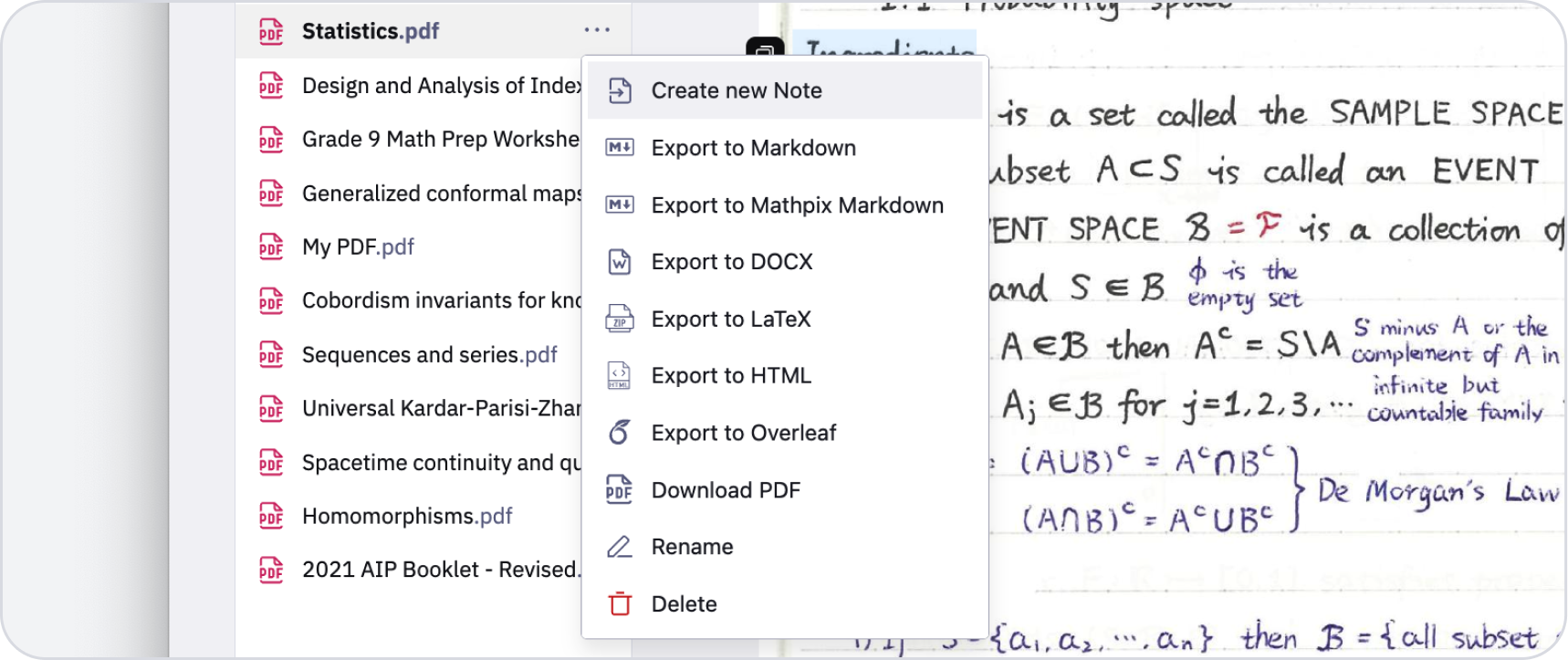
- One upload, then export to any format
- Page ranges, so you convert only the pages you need
- Works on scanned PDFs and on born-digital ones
One recognition pass, eight output formats
The conversion happens once and the format is chosen at export time, which is why the outputs are consistent with one another rather than separate best guesses at the same page. Unfamiliar with a term here? The glossary covers them.

Recognized once, exported many times
Every PDF is read into Mathpix Markdown first. The Word file and the LaTeX come from the same parse of the same page, so they agree with each other.

Tables keep their structure
Cells that span rows or columns come back tagged rather than flattened, so a table stays a table in the export.

Journal layouts read in order
Two- and multi-column pages come back as continuous text instead of interleaved columns.
What Mathpix recognizes in a PDF
Reading order on multi-column pages
v3/pdf applies document-layout recognition automatically, so a two-column journal page comes back as continuous text.
Algorithms keep their line structure
Recognized as their own blocks rather than reflowed into prose: the lines.json conversion format returns code and pseudocode line types.
Merged cells and multi-row headers
Cells spanning rows or columns come back tagged, with spanning and split subtypes on the table_cell line type in lines.json.
Captions stay with their figures
Both are annotated structures in their own right, kept with the figure or the page they belong to.
Per-line geometry and confidence
The lines.json conversion format returns a bounding box and a confidence score for every line, so a conversion can be audited rather than trusted.
Page selection and numbering
page_ranges takes only the pages you want, include_page_breaks keeps the boundaries, and remove_section_numbering strips numbering from headings.
We are very satisfied with the Mathpix API. The service is remarkably fast and accurate, and we are very pleased with the excellent quality.
How to convert PDF to Any Format
1
Upload your PDF
Drag it into the Mathpix Snip web editor, or pick it from your files.
2
Convert it to Any Format
Recognition runs on the whole document: math, tables, figures and layout together.
3
Export or copy the Any Format
Download the Any Format, or copy it straight to the clipboard and paste it where you need it.
What Mathpix accepts, and the limits that apply
Which files you can send
PDF, EPUB, Word (DOCX, DOC), PowerPoint (PPTX), OpenDocument Text (ODT), DjVu, WordPerfect (WPD), Mobipocket (MOBI) and Amazon Kindle (AZW3)
What you get back
Mathpix Markdown, DOCX, LaTeX, HTML, Markdown, PDF, PPTX and XLSX. Mathpix Markdown, Markdown, LaTeX and HTML are also available as a zip that carries the extracted images.
The size limits that apply
One PDF, uploaded: 1 GB
Files API, per file: 15 GB
Files API, files per job: 200,000
Our PDF to Any Format tools
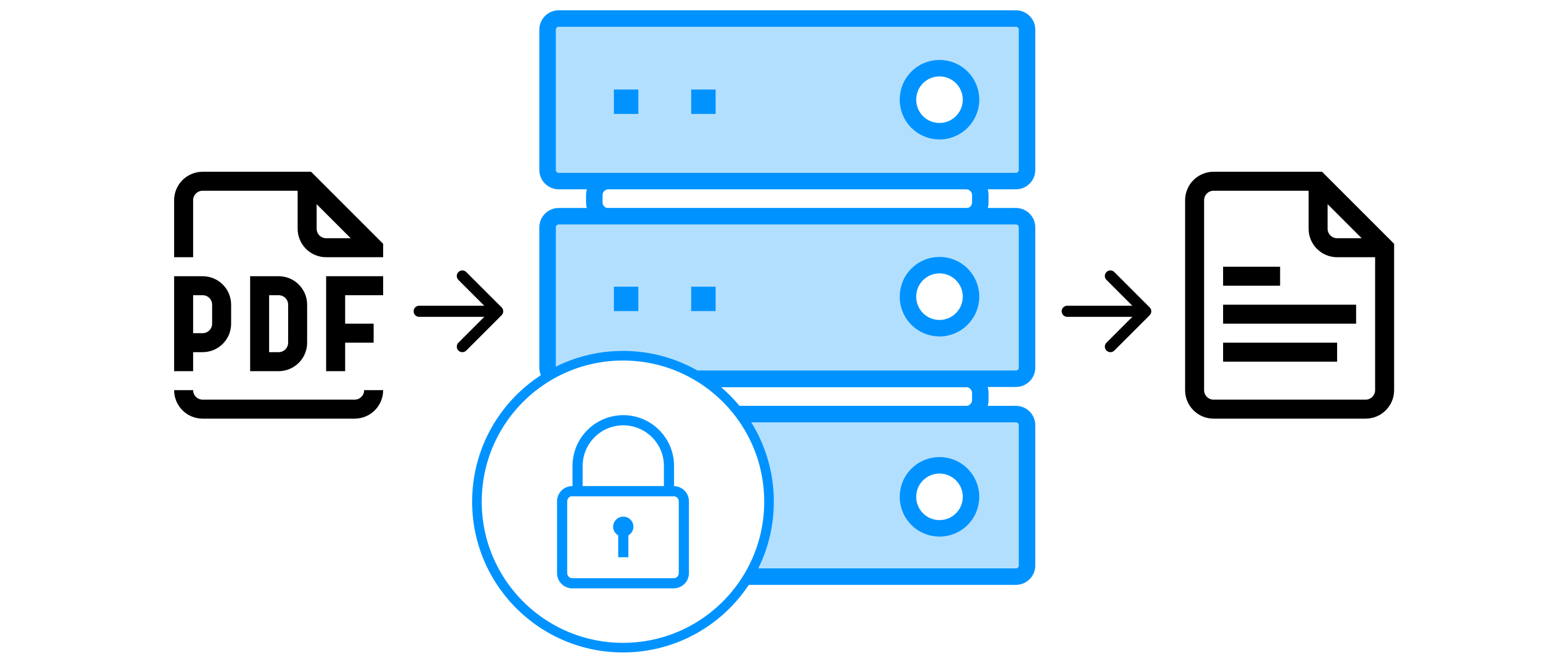
On-premise PDF Cloud
Use all PDF processing features with a self-hosted, fully contained solution.
Learn more
Converting PDF to Any Format: common questions
Does it work on scanned PDFs, or only on PDFs with a text layer?
Both. A scanned page goes through OCR; a born-digital page is read directly. You do not choose, and you do not need to know which one you have.
Can I convert part of a long document?
Yes. page_ranges on the API, or the page range box in the web app. You are billed for the pages you convert, not the pages in the file.
What happens to equations?
They are recognized as math, not as pictures of math, and then written into whatever the output format uses: LaTeX source, native Word equations, or MathJax on a web page.
How large a file can I send?
One GB for a single PDF. For collections beyond that, the Files API takes 15 GB per file and 200,000 files per job.
Other formats you can convert PDF to
See it on real documents
See examples of every conversion format.
PDF to Word
Convert PDFs to editable Word documents.
PDF to LaTeX
Convert PDFs to clean LaTeX source code.
PDF to Markdown
Convert PDFs to Mathpix Markdown.
Keep the reading order on journal pages
Two-column layouts, resolved during recognition.
Line-by-line JSON with geometry
Structured output for a pipeline rather than a reader.
A PDF into an editable deck
PPTX with equations you can still edit.
PDF tables into a spreadsheet
Excel, Google Sheets or TSV from the same upload.
A PDF onto a web page
HTML that reflows, with MathJax equations.
Straight into an Overleaf project
No download and re-upload.